Radio Controlled and Atomic Clocks
Indoor/Outdoor Atomic Clocks
LaCrosse Technology, Chaney Instruments, Acur-Rite, Atomix
How Atomic/Radio Controlled Clocks Work?
Atomic clocks keep time better than any other clock. They even keep time better than the rotation of the Earth and the movement of the stars. Without atomic clocks, GPS navigation would be impossible, the Internet would not synchronize, and the position of the planets would not be known with enough accuracy for space probes and landers to be launched and monitored. Atomic clocks are not radioactive.
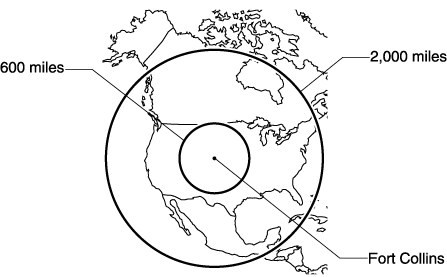
Many gadget catalogs and high-tech stores sell "radio-controlled" clocks and wrist watches that are able to receive these radio signals. These clocks and watches truly are synchronizing themselves with the atomic clock in Colorado. This feature is made possible by a radio system set up and operated by NIST -- the National Institute of Standards and Technology, located in Boulder, Colorado. NIST operates radio station WWVB, which is the station that transmits the time codes. It has high transmitter power (50,000 watts), a very efficient antenna and an extremely low frequency (60,000 Hz). For comparison, a typical AM radio station broadcasts at a frequency of 1,000,000 Hz. The combination of high power and low frequency gives the radio waves from WWVB a lot of bounce, and this single station can therefore cover all of the continental United States plus much of Canada and Central America as well.
The time codes are sent from WWVB using one of the simplest systems possible, and at a very low data rate of one bit per second (for comparison, a typical modem transmits over the phone lines at tens of thousands of bits per second. The 60,000 Hz signal is always transmitted, but every second it is significantly reduced in power for a period of 0.2, 0.5 or 0.8 seconds:
0.2 seconds of reduced power means a binary zero
0.5 seconds of reduced power is a binary one.
0.8 seconds of reduced power is a separator.
The time code is sent in BCD (Binary Coded Decimal) and indicates minutes, hours, day of the year and year, along with information about daylight savings time and leap years. The time is transmitted using 53 bits and 7 separators, and therefore takes 60 seconds to transmit.
A clock or watch can contain an extremely small and relatively simple antenna and receiver to decode the information in the signal and set the clock's time accurately. All that you have to do is set the time zone, and the clock can display a very accurate time. The only thing more accurate that you can carry around easily is a GPS receiver, which derives atomic clock accuracy in real time from the atomic clocks in orbiting GPS satellites.
Radio Signals
North America